
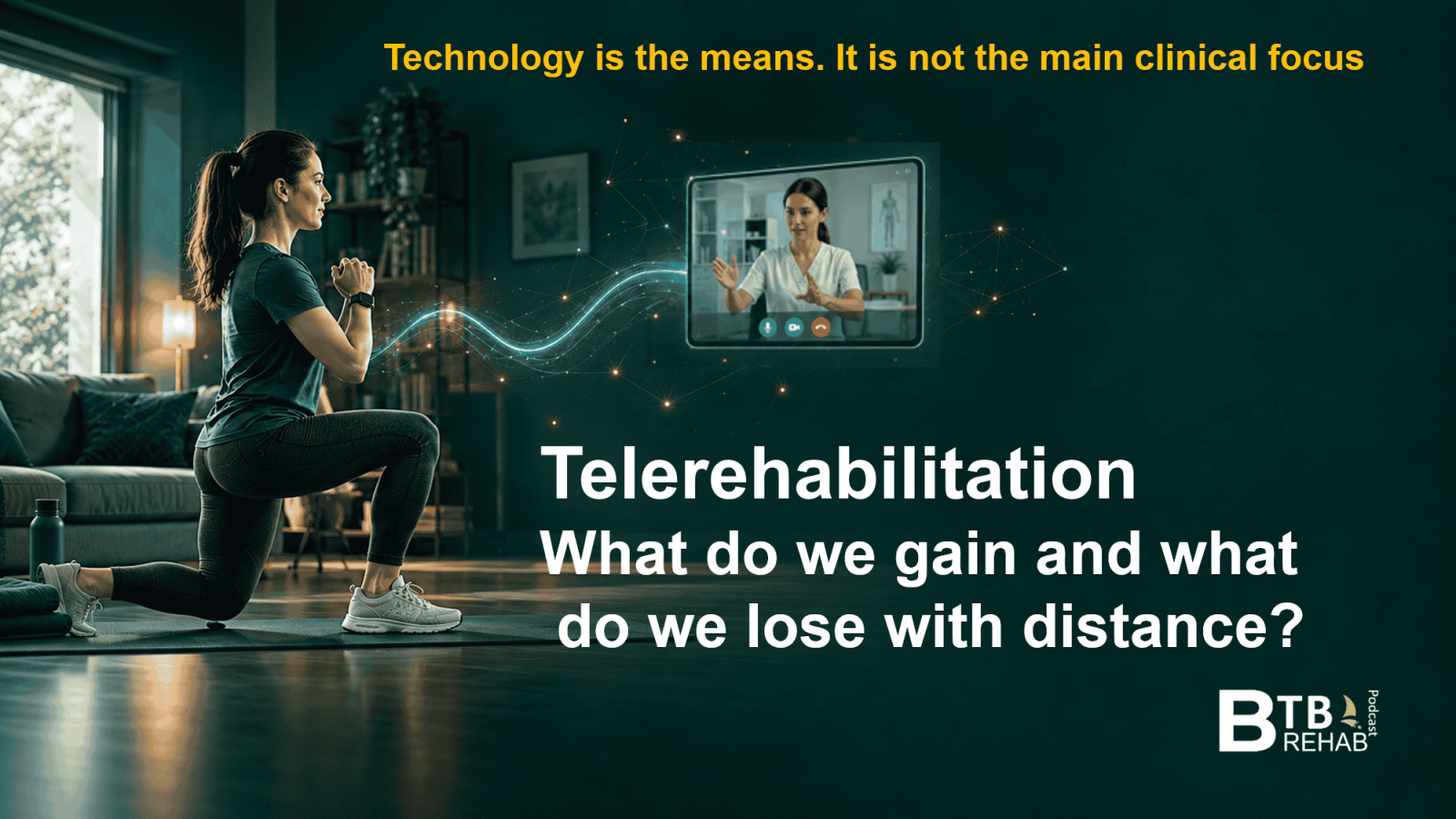
Technology is the means. It is not the main clinical focus.
Can rehabilitation assessment and intervention be delivered remotely while maintaining clinical quality, safety and a meaningful therapeutic relationship?
In this episode of the BTB Rehab Podcast, we discuss telerehabilitation as a clinical practice. We distinguish it from the broader concept of digital health and from artificial intelligence, which may be used as a tool but is not a requirement for telerehabilitation.
Rather than asking whether remote consultations are identical to in-person consultations, we explore a more clinically relevant question:
Is remote care clinically sufficient for the decision we need to make?
What you’ll learn
- What telerehabilitation means in clinical practice;
- Which components of consultation and assessment can be performed remotely;
- Which therapeutic interventions can be delivered safely at a distance;
- When in-person contact remains necessary;
- What may be gained by observing a person in their usual environment;
- What may be lost without therapeutic touch;
- How distance can affect the therapeutic relationship;
- How telerehabilitation may contribute to equity and access;
- How personal devices, such as smartphones, may support remote care;
- Why hybrid models may be appropriate for many clinical situations;
- Why artificial intelligence is only one possible tool, not the definition of telerehabilitation;
- Why clinical judgement remains central to selecting the most appropriate care modality.
Clinical relevance
Especially useful for clinicians working with:
- Musculoskeletal rehabilitation;
- Neurological rehabilitation;
- Cardiopulmonary rehabilitation;
- Cardiac rehabilitation;
- Speech and language therapy;
- Rehabilitation in older adults;
- Community and home-based rehabilitation;
- Remote follow-up and hybrid care models.
📌 Take-home message
Telerehabilitation is not a universal replacement for in-person care.
It is a different way of delivering rehabilitation, with specific advantages, limitations and clinical requirements.
Remote care may be appropriate when the person is clinically stable, the therapeutic task is observable and predominantly active, the environment is safe, and the person can participate with or without support.
In-person care remains essential when the clinical decision depends on physical examination, palpation, manual assistance, high-risk assessment or direct contact.
The most defensible approach is selective and adaptable:
in-person when presence is clinically necessary, remote when distance does not reduce quality, and hybrid when both modalities are needed.
Apply this in your clinical practice
Core (5€)
• Summary
• Infographic
Premium (8€)
- Core materials
- Final Report
- Implementation Outpatient Toolbook
Get full clinical tools, not just theory.