
From evidence to clinical decision-making

If you want to make better clinical decisions based on evidence, this podcast is for you.
We help you translate research into practical clinical decisions by combining clinical expertise with AI. 
– Listen to the latest episode
– Access clinical resources (summaries, infographics, and practical tools)
- Full materials, reports, and clinical templates are available on Patreon.
“Knowing is not enough; we must apply. Willing is not enough; we must do” (Goethe)
Search our database, we are periodically adding new episodes.
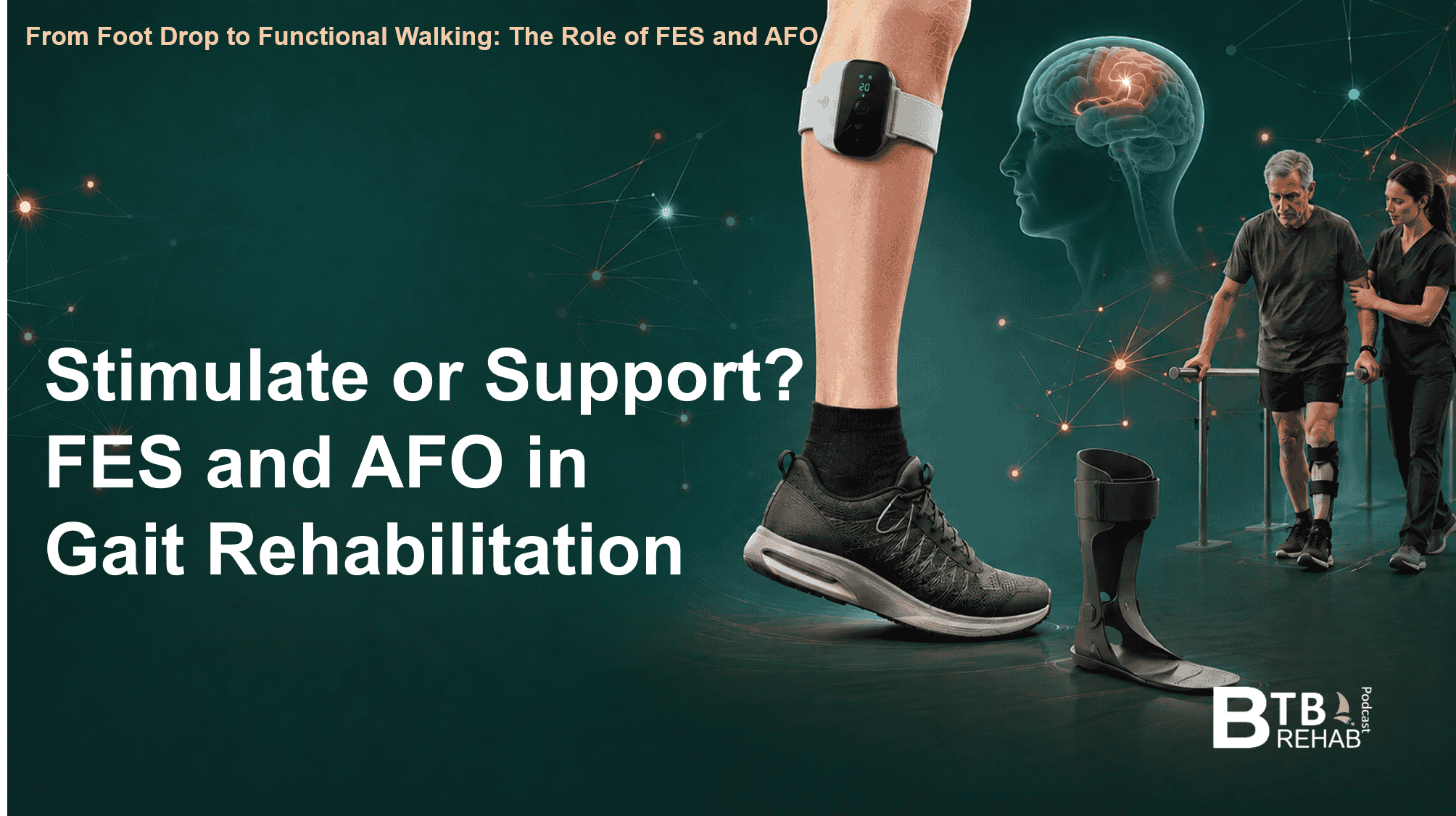
EP09 — Stimulate or Support? FES and AFO in Gait Rehabilitation
In this episode of the BTB Rehab Podcast, we explore the role of two commonly used strategies in gait rehabilitation: functional electrical stimulation (FES) and the ankle-foot orthosis (AFO).
Rather than asking which option is universally better, we focus on a more clinically relevant question: how do we decide which approach is most appropriate for each person?
EP08 EN — The Tendon: What Actually Drives Pain and Recovery?
If you still think of the tendon as a passive or inflamed structure, this episode may change how you approach clinical decision-making.
In this episode of the BTB Rehab Podcast, we explore what the tendon actually is, how it behaves under load, and why that matters for rehabilitation outcomes.
EP07 EN — Real-World Data in Rehabilitation: What Actually Works?
If you’re collecting more and more data but not seeing clearer clinical decisions, this episode may change your perspective.
In this episode of the BTB Rehab Podcast, we explore what real-world data actually supports in outpatient rehabilitation, and why more data is not always better.
EP06 EN — BFR: Science or Hype?
Blood Flow Restriction (BFR) is becoming increasingly popular in rehabilitation — but is it a clinically useful tool or just another trend?
In this episode of the BTB Rehab Podcast, we critically review the current evidence and explore how BFR can be used as a load management strategy when high-load training is not feasible.