
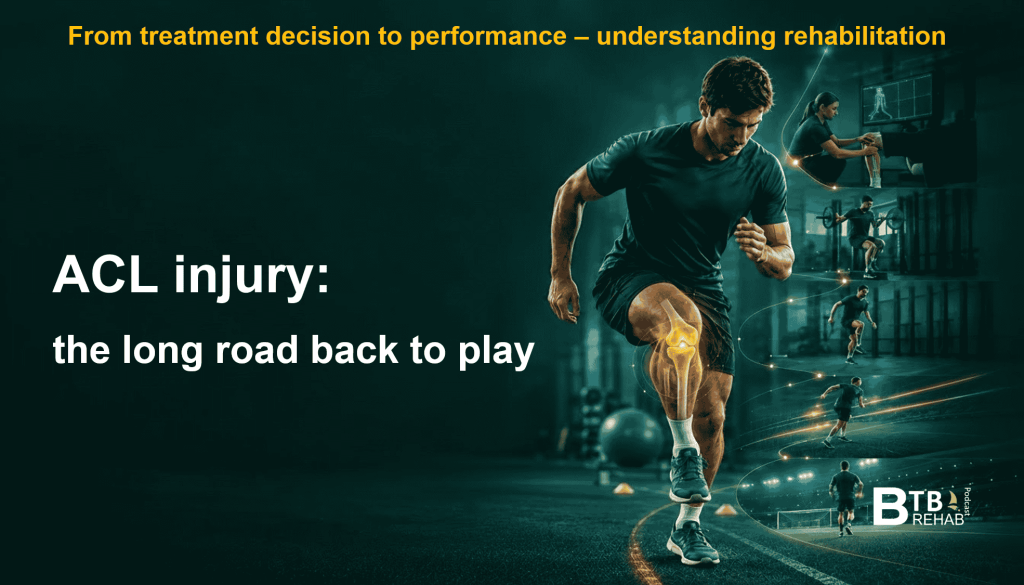
EP12 — ACL Injury: The Long Road Back to Play
What does it really mean to return to play after an anterior cruciate ligament injury?
c
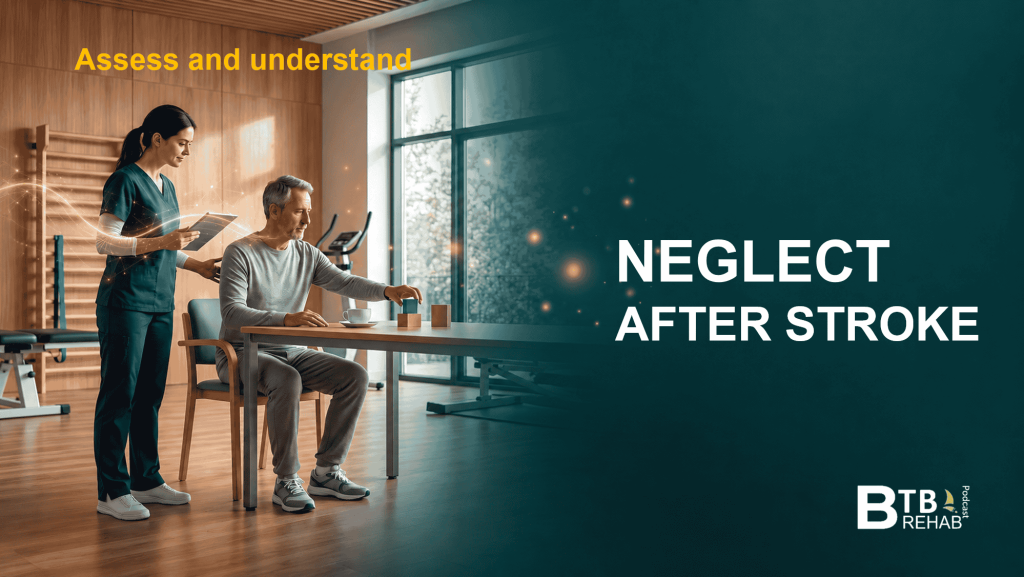
EP11 — Spatial Neglect After Stroke: Assess and Understand
How can we recognise neglect after stroke and understand its real-world impact before deciding how to intervene?
In this episode of the BTB Rehab Podcast, we discuss neglect after stroke as a heterogeneous clinical syndrome that may affect spatial attention, body representation and the orientation of action.

EP04 EN – Evidence-Based Practice: How to Make Better Clinical Decisions
Evidence-Based Practice is often misunderstood in rehabilitation. It’s not just about following research papers – it’s about making better clinical decisions by integrating scientific evidence, clinical expertise, and patient values.
Narrowing the physiotherapy knowledge-practice gap: faculty training beyond the health sciences
(2023)”Physiotherapists seek to improve client movement and promote function within an individual’s unique environmental and social realities. Despite this intention, there is a well-noted knowledge-practice gap, that is, therapists generally lack sufficient foundational preparation to effectively navigate societal challenges impacting contemporary healthcare. As one step toward addressing the issue, we propose an educational solution targeting current and future physiotherapy faculty, whose responsibilities for entry-level course development and curriculum design substantially impact student readiness for clinical practice. We propose that physiotherapy faculty trained via postprofessional education in a non-biomedical field (e.g. psychology, education, and philosophy) will be uniquely prepared to provide students with tools for dealing with complex social issues facing their clients; critical analysis skills; statistical and technological training; and a deeper theoretical and philosophical understanding of practice. Taken together, such interdisciplinary tools could help address the knowledge-practice gap for physiotherapists and promote the ongoing evolution of the profession in concert with contemporary healthcare. Physiotherapists who pursue interdisciplinary studies may more deeply understand the challenges faced by clinicians and may be well-positioned to leverage knowledge and methods in another scientific discipline to expand and transform the scope of solutions to these challenges.”
Factors guiding therapist decision making in the rehabilitation of physical function after severely disabling stroke – an ethnographic study
(2022)🔓”Whilst strong evidence supports rehabilitation to improve outcomes post-stroke, there is limited evidence to guide rehabilitation in the most severely disabled group. In an era of evidence-based practice, the aim of the study was to understand what factors guide physiotherapists (PTs) and occupational therapists (OTs) to select particular interventions in the rehabilitation of physical function after severely disabling stroke.”