
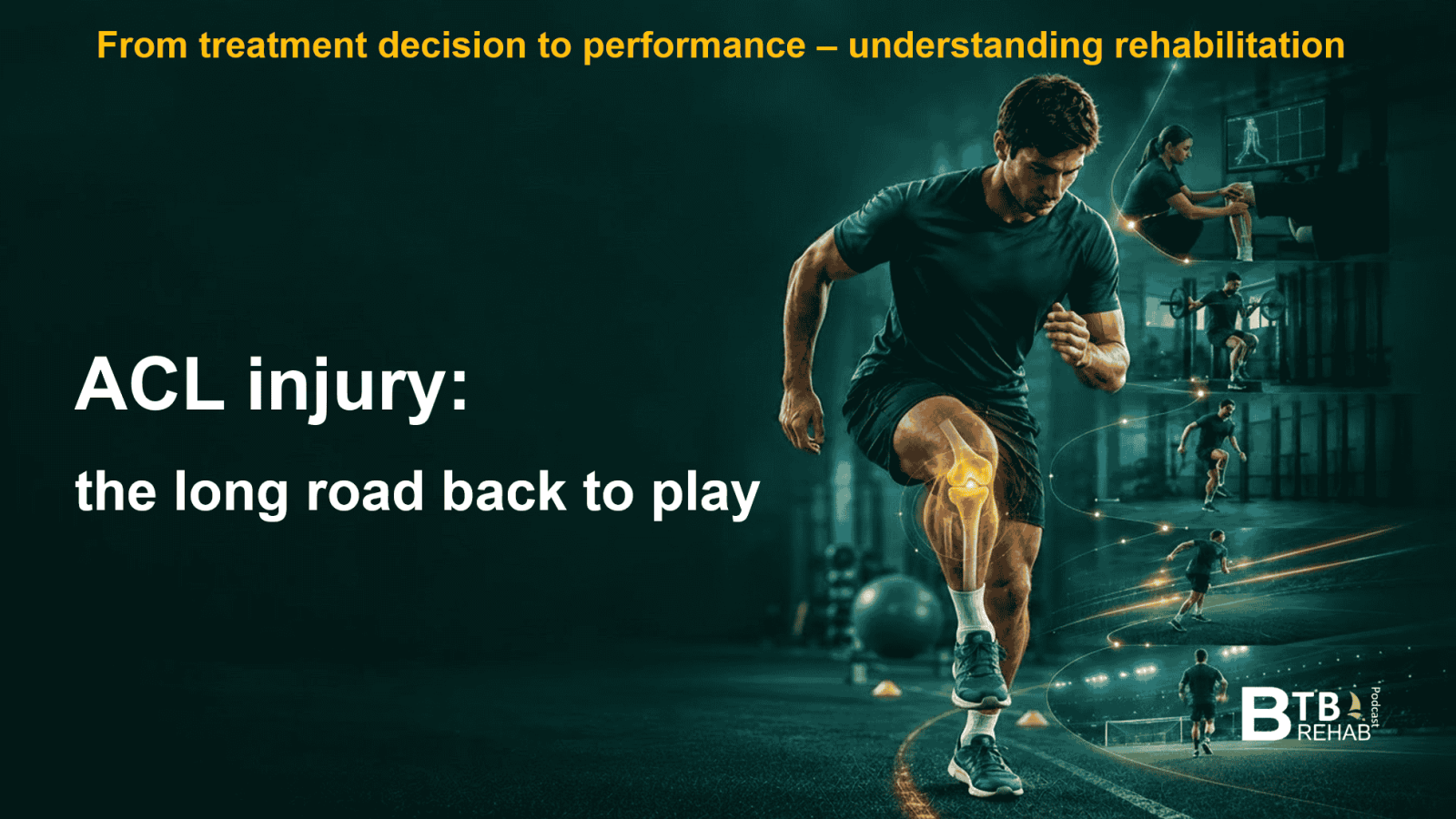
From Treatment Decision to Performance
What does it really mean to return to play after an anterior cruciate ligament injury?
In this episode of the BTB Rehab Podcast, we explore ACL injury in football, from treatment decision-making to the return to training, competition and performance.
ACL reconstruction may be an appropriate option in certain contexts, but it should not be understood as an automatic answer. The decision should consider functional knee stability, associated injuries, the person’s goals, the response to rehabilitation and the demands of the sport.
In selected cases, a non-surgical approach based on structured rehabilitation and ongoing reassessment may also be considered.
The public cases of Rodrygo, Sam Kerr and Khvicha Kvaratskhelia are used only as starting points to provide context. We do not analyse their individual clinical pathways or make inferences about their treatment, prognosis or return-to-play criteria.
What you’ll learn
- What an anterior cruciate ligament injury involves;
- How the demands of football influence treatment decision-making;
- What ACL reconstruction involves;
- When a non-surgical approach may be considered;
- Why prehabilitation matters;
- How rehabilitation progression is structured;
- The role of mobility, strength and neuromuscular function;
- How progression moves from running to acceleration, deceleration and changes of direction;
- The difference between return to training, return to competition and return to performance;
- Why time since surgery should not be the only decision criterion;
- The risk of a second ACL injury;
- Why prevention and follow-up should continue after return;
- How to interpret differences reported between female and male athletes.
A clinically useful approach combines:
- Sports rehabilitation;
- Anterior cruciate ligament injuries;
- Football and other sports involving acceleration, deceleration and changes of direction;
- Surgical and non-surgical treatment decision-making;
- Criteria-based rehabilitation;
- Return to training, competition and performance;
- Second-injury prevention;
- Individualised assessment after ACL reconstruction.
📌 Take-home message
ACL reconstruction is not the only question, and time is not the only criterion.
Treatment decisions should consider knee stability, associated injuries, the person’s goals, the demands of the sport and the response to rehabilitation.
Return to play should be an individualised progression based on clinical, functional, psychological and football-specific criteria.
The goal is not simply to return to competition. It is to regain the capacity to tolerate the demands of the sport and, where possible, approach the previous level of performance.
Assess the profile. Understand the activity. Measure what matters.
Apply this in your clinical practice
Core (5€)
• Summary
• Infographic
Premium (8€)
- Core materials
- Final Report
- Implementation Outpatient Toolbook
Get full clinical tools, not just theory.